
▲The NYCU team, led by Professor Wen-Liang Chen, showcases the award-winning ‘GenOMe’ platform—a modular, LEGO-like system that accelerates microbial strain development from months to just a few days © NYCU Elite
The international Genetically Engineered Machine (iGEM) Competition is the world’s largest-scale student competition in synthetic biology, attracting approximately 300 teams to participate each year. In the 2025 competition, National Yang Ming Chiao Tung University (NYCU) won the gold medal with its “Genomic Integrated Bio-Brick Platform (GenOMe)” and was nominated for two special awards. GenOMe employs a standardized, modular design like LEGO bricks, supplemented by precise mathematical modeling for prediction, which dramatically increased the success rate of genome integration technology from 0.2% to 80%
This means that the time required for culturing and screening microbial strains, which previously could last for six months to a year, will be reduced to a few weeks or even a few days in the future. This development demonstrates tremendous value for both commercial and clinical applications and has earned high praise from international reviewers.
Solving Biological Problems with an Engineering Mindset
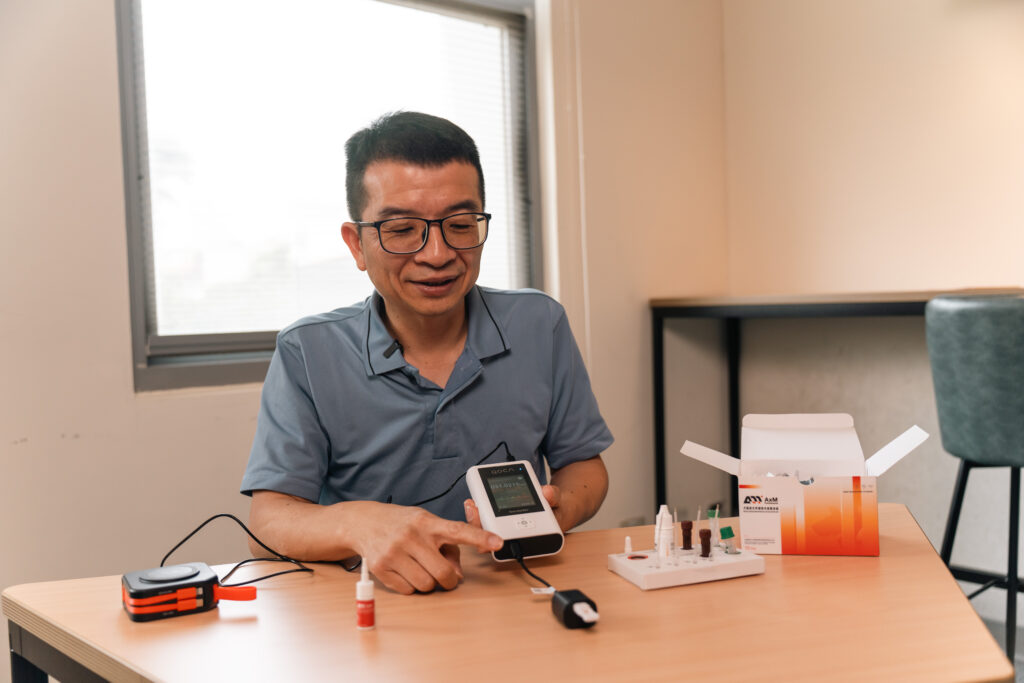
Wen-Liang Chen, the Professor of the Department of Biological Science and Technology at NYCU, who has served as the iGEM team leader since 2013, pointed out that the Massachusetts Institute of Technology (MIT) founded iGEM with the aim of applying an engineering mindset to solve problems faced in biological research. The hope is that, by modularizing genes as building blocks, they can be arranged and combined according to research objectives to create “biological machines” with specific functions capable of performing specialized tasks. NVIDIA founder Jensen Huang also publicly stated that biology will evolve from the “science of discovery” toward the “science of engineering” in the future.
“While there is a certain element of romance and artistry to discovery, engineering must have clear objectives,” Prof. Chen emphasized. He noted that during the iGEM competition participation and training program, NYCU instructors did not proactively provide answers; instead, they allowed students to take the lead to a large extent in defining problems, seeking resources, and solving issues.
For example, the team had originally planned to refine GenOMe and develop new applications as their entry for the 2026 competition, but if students decided at the last minute to change the topic, Prof. Chen respected their decision: “Even if there wasn’t enough time, students must take responsibility. Regret is sometimes an indispensable part of education.”
Project-Based Learning and Solution in the Age of Information Explosion
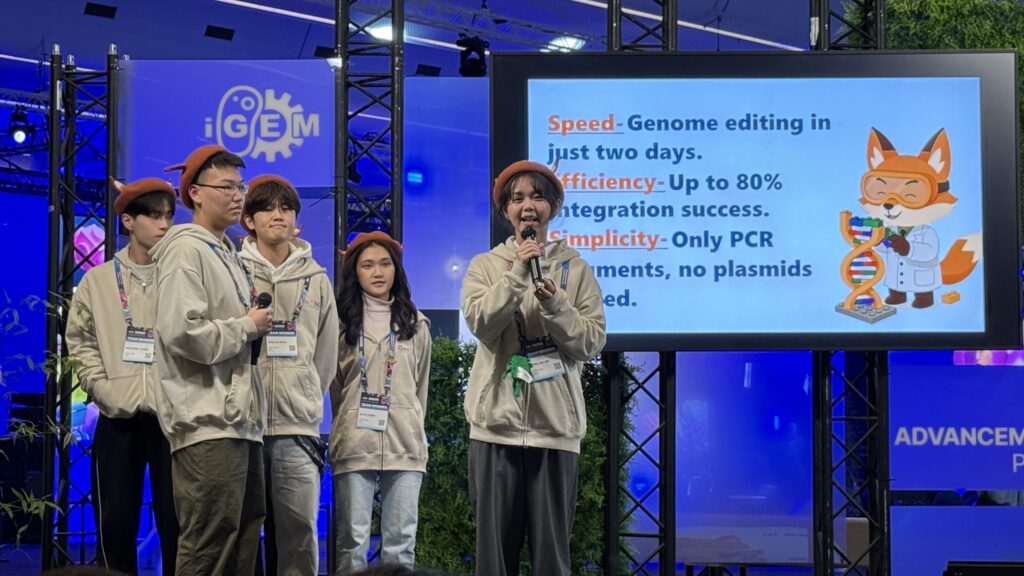
The members of NYCU’s iGEM team come from diverse backgrounds. The team in 2025 consists of 18 freshmen students from the Department of Biological Science and Technology, the Department of Electronics and Electrical Engineering, the School of Medicine, the Department of Biotechnology and Laboratory Science in Medicine, and the Department of Computer Science. “The most challenging part was mathematical modeling, which could not be accomplished by students with a computer science background alone. The equations for GenOMe were developed collaboratively by members from the Department of Biological Science and Technology, the School of Medicine, and the Department of Computer Science,” said Prof. Chen.
In this type of Project-Based Learning (PBL) training, if students discover that they lack skills in areas such as experimental methods or mathematical modeling during the problem-solving process, they must take the initiative to learn and fill in the gaps in their fundamental science knowledge. Prof. Chen added, “AI generates content at an astonishing rate. In this era of rapidly expanding knowledge and rapid AI development, it is more important for students to learn to set goals so that they can efficiently filter out the content they truly need!”
It is particularly worth noting that in 2023, the team was even led by a student from the College of Humanities, Arts, and Social Sciences. The team introduced the concept of “BioArt,” using engineered bacteria combined with the three primary RGB colors to create various patterns, and even organized an online art exhibition and expert lectures. “By combining soft elements into the rigid concepts of engineering and biology, the team completely overturned conventional notions of what biology and engineering can be!” Prof. Chen said with a grin.
Proactive Seeds Eventually Blossom and Bear Fruit
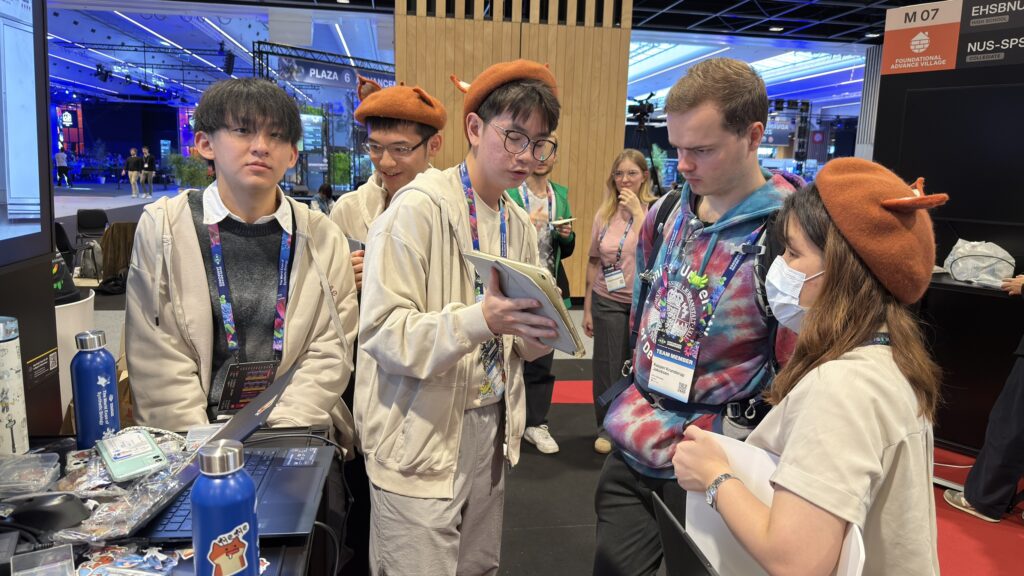
In addition, Prof. Chen observed that iGEM places great emphasis on the “Integrating Human Practices” aspect of its competition design, which is highly inspiring for education. “The concept of this competition design is to have teams demonstrate whether their technology makes a tangible contribution to society and industry.” He further explained that if participants treat their entry as a startup product, students must engage with other researchers and industry professionals during the R&D phase. This not only helps them understand the genuine needs of these stakeholders and adjust their R&D direction accordingly, but also enables them to gain recognition for their research concepts and value.
“We’ve had students ride their scooters all the way from Hsinchu to the Taiwan Agricultural Research Institute, Ministry of Agriculture, in Taichung, to discuss the accuracy of predictive models with researchers. Some students had personally written letters inviting the director of the Academia Sinica to grant an interview. Students reached out not only to research institutions but even to businesses on their own initiative.” Prof. Chen recalled that if the content of a student’s invitation letter was insufficient, the process of securing an interview was bound to encounter setbacks. It was only then that instructors stepped in to guide students in refining their interview invitation process. “As long as we can plant the seed of initiative in students’ minds, the energy they bring to society one day will be truly remarkable.”
Before officially announcing the entry, he will help students continuously improve their spoken English skills, with the goal of being able to explain the key features of the entry in 3 to 5 minutes. “At the iGEM exhibition, students couldn’t just sit there waiting for people to come to them. I also told the students they must take the initiative to invite students from other universities or judges to visit the NYCU booth.” Prof. Chen’s strict demands on the iGEM team members finally bore beautiful fruit when the students used their award-winning theme to launch a startup.
Taking Bold Steps and Exploring Endless Possibilities
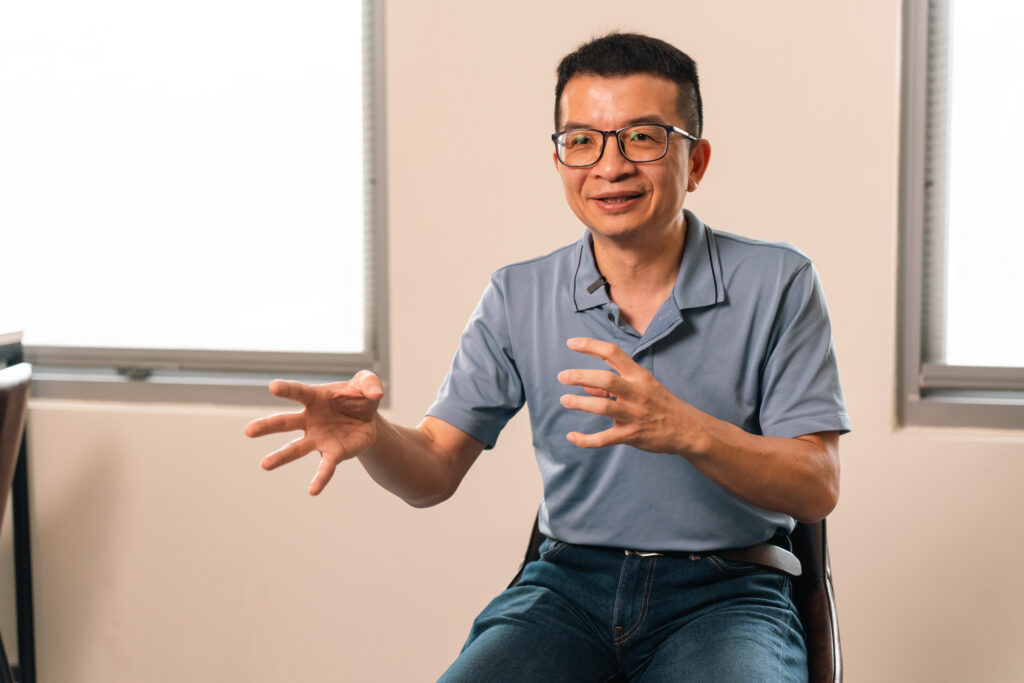
Since 2014, Prof. Chen’s team has won numerous iGEM grand awards and gained recognition over several consecutive years with their “Toxin-Free Smart Technology Agricultural System (AgriTalk),” which integrates technologies such as biotechnology, AI, and the Internet of Things to provide functions including pest control and environmental monitoring. Encouraged by Jason Yi-Bing Lin, the then Vice President of NYCU, Prof. Chen, and the iGEM student team refined their prototype concept into a commercializable system and established the startup “AgriTalk” in 2019.
This group of students, forged through the iGEM competition, brought the spirit of initiative and proactively promoted themselves from the competition into the business world. Early in its startup journey, AgriTalk successfully invited the CTO of a major international corporation to visit its booth at CES in the U.S. with a precise one-minute presentation. “That year at the event, we generated approximately 1 billion dollars in business opportunities, with companies from over 30 countries expressing interest in having us set up manufacturing facilities there.” Although we can only precisely partner with a few companies due to their limited scale, Prof. Chen remains immensely proud of his students’ achievements in their first entrepreneurial venture.
Another project previously recognized by an iGEM grand award and made by Prof. Chen’s team is the “Smart Disease Detection Platform,” which employs an innovative technology that combines engineered bacteria with chips. This approach has not only significantly increased the biochip manufacturing yield—from less than 10% to over 90%—but also enables high-precision, rapid testing service for disease markers in pets. This technology has already attracted corporate partners to jointly collaborate, and the team is poised to formally enter the semiconductor and biomedical sensor markets through technology transfer and mergers and acquisitions.
“Be brave enough to take the leap and give it a try. No matter the outcome, one will gain a wealth of experience, and that will encourage one to venture into new fields in the future.” Prof. Chen’s words of encouragement to students eager to take on the iGEM challenge were concise yet powerful. In fact, Prof. Chen and the NYCU members, who once underwent the grueling “ordeal” of iGEM together, are the living embodiment of these words. For them, winning an iGEM award is not the end goal, but rather a fresh starting point for entering the industry, solving social problems, and changing the human world.
Interview | Fu-Kuo Chu
Translation | Yi-Chen Emily Li
Editing | Hsiu-Cheng Faina Chang / StoryLab
Photographer | Hao-Yun Peng and Yen-Yu Shih / ZDunemployed studio
©NYCU ELITE